

Marcus Bell, Staff Writer.
You know the bottle. It sits on the dresser, three-quarters full, the one you bought two winters ago and now reach for out of habit more than excitement. By noon it has faded to something you can only smell if you press your wrist to your nose. You have started to wonder if the formula changed, or if you did.
It is neither. Fragrance longevity and how a scent reads on skin have almost nothing to do with the price on the box and almost everything to do with where you put it, what your skin is doing underneath it, and how you layer the rest of your routine on top. A 2021 study in the International Journal of Cosmetic Science found that skin hydration levels measurably affect how long fragrance molecules stay detectable on the skin’s surface, which is one reason the same spray smells different in July than in January.
This is not an argument for buying anything new. It is a short course in getting more out of what is already sitting on your dresser.
- Hydrated skin holds scent longer: dry skin lets fragrance evaporate faster, so a plain unscented lotion under your perfume can outperform a heavier hand with the bottle.
- Pulse points are a myth in isolation: fragrance clings best to skin with more surface area and warmth, including hair and clothing fibers, not just wrists and neck.
- Storage habits quietly ruin formulas: light, heat, and bathroom humidity break down fragrance oils over months, which is often why a beloved bottle smells “off” before it is empty.
Why The Same Bottle Smells Different On Different Days
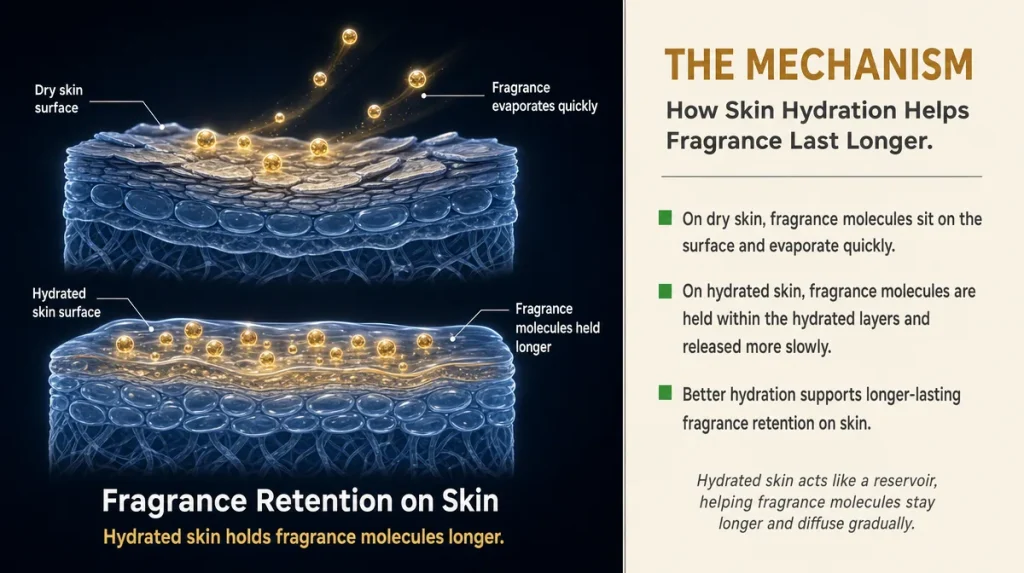
Fragrance is not a fixed object. It is a chemical reaction between the oils in the bottle and the oils, moisture, and temperature of your skin. Think of your skin as the paper a watercolor is painted on: the same pigment looks different on damp paper than on dry paper, and it looks different again once the paper dries fully.
Dry skin has less oil to bind fragrance molecules, so top notes flare up fast and disappear. Well-moisturized skin holds those molecules closer to the surface longer, which slows evaporation and extends the middle and base notes you actually paid for. This is why the same eau de parfum can feel bright and short-lived in a heated apartment in February and warmer, longer-lasting in humid August.
Skin pH plays a role too. Slightly more acidic skin tends to make citrus and green top notes read sharper and fade quicker, while more neutral skin lets floral and woody notes settle in more smoothly. None of this is something you can change permanently, but you can work with it.
Self-test: spray your perfume on your wrist right after a shower, before any lotion, and again an hour after applying an unscented moisturizer on the other wrist. Smell both at the two-hour mark. Most people notice a real difference in strength, not just imagination.
Layering Before You Spray, Not After
The order of operations matters more than most people assume. An unscented, or very lightly scented, body lotion applied a few minutes before your perfume gives the fragrance something to hold onto. Petroleum jelly on pulse points works the same way for people who prefer not to add another product to the routine, though it can shift how top notes present, making them softer and slower to open.
The mistake many people make is applying perfume immediately after a hot shower, while skin is still damp. Water on the skin dilutes the fragrance oils and can wash away molecules before they settle. Waiting until skin is fully dry, then applying a barrier layer, gives the fragrance a stable surface to sit on.
Another common error is rubbing wrists together after spraying. It feels instinctive, almost ceremonial, but the friction generates heat that breaks down the more delicate top notes before they have a chance to develop. Dabbing gently, or simply letting the spray dry in the air, preserves the fragrance’s intended opening.
A 2019 review in the Journal of Cosmetic Science noted that friction and rubbing accelerate the volatilization of top-note aromatic compounds, shortening how long they remain perceptible.
Where To Actually Spray It

Pulse points get all the credit, but they are only part of the story. Wrists and neck work because they carry warmth close to the surface, and warmth helps fragrance diffuse into the air around you. But hair and clothing hold scent for hours longer than skin does, because fabric and hair fibers do not have the same moisture and oil turnover that skin does.
A light mist on the ends of your hair, or on a scarf before you leave the house, often outlasts anything applied directly to skin. This is not a reason to spray perfume directly onto delicate silk or fine wool, which can stain, but a scarf, a coat lapel, or the inside of a bag lining can hold fragrance for a full day.
The often-repeated advice to spray into the air and “walk into it” wastes most of the product, since the majority of it never reaches your skin or clothing at all. It is better suited to testing a scent you are unsure about than to applying one you already know you like.
Self-test: spray your usual amount on your wrist and a similar light mist on a cotton scarf or scrunchie. Smell both the next morning. Most people are surprised by how much stronger the fabric reads.
What Eau De Parfum Concentration Actually Tells You
Eau de parfum sits in the middle of the concentration scale, typically holding a higher percentage of fragrance oil than an eau de toilette but less than a pure parfum or extrait. In practical terms, this usually means moderate projection and a lifespan of roughly four to eight hours on skin, though individual skin chemistry shifts this considerably.
What the concentration label does not tell you is how the fragrance was built. Two eau de parfums with the same percentage of oil can behave completely differently depending on which notes were used and how they were blended. A citrus-forward formula will always fade faster than an amber or musk-based one, regardless of concentration, because citrus molecules are lighter and evaporate more quickly by nature.
This is worth knowing because it reframes a common frustration. If your eau de parfum seems to vanish within two hours, the issue may not be the product’s strength but its note family. Layering technique and skin prep can extend a citrus scent’s life, but they cannot make it behave like a base-heavy oriental fragrance built for endurance.
Storing Perfume So It Does Not Turn On You
A bottle of eau de parfum is a mix of alcohol, water, and aromatic compounds, and all three degrade under light and heat. The bathroom, where many people keep their fragrance next to the mirror, is close to the worst possible location: steam from showers introduces humidity, and the fluctuating temperature speeds up oxidation of the oils.
A cool, dark drawer or a closed cabinet away from a window does far more to preserve a fragrance than any ritual applied at the moment of spraying. Direct sunlight is especially damaging, since UV exposure breaks down aromatic compounds and can visibly darken the liquid over months.
Most eau de parfums, once opened, hold their character well for about one to three years, though this varies by formula. Signs a bottle has turned include a sharper, more alcohol-forward smell than you remember, a darker color, or top notes that seem to have disappeared entirely, leaving only a flat base.
A 2020 paper in Flavour and Fragrance Journal documented measurable oxidation and color change in fragrance samples stored at elevated temperatures over several months, compared with samples kept in cool, dark conditions.
Self-test: compare the color of the liquid against a photo of the bottle when new, if you have one, or against an unopened backup if you keep one. A noticeably darker or amber tint in a formula that started pale is a reasonable sign it has begun to degrade.
How Much Product Actually Reads As “More”
There is a persistent idea that more sprays equal a stronger, longer-lasting scent, and it is only partly true. Fragrance follows a curve, not a straight line: past a certain point, additional product increases how far the scent projects into a room but does not meaningfully extend how long you personally can smell it, because your nose adapts to a familiar scent within minutes, a phenomenon called olfactory fatigue.
This is why people who wear the same fragrance daily often stop noticing it entirely by midmorning, even though people around them still can. Overspraying to compensate usually just increases the strength others perceive, sometimes past a comfortable level, without solving the wearer’s own sense that the scent has faded.
A more effective habit is applying to two or three points rather than one heavy application to a single spot, since this distributes the scent across a wider surface area without overwhelming any single point. Two sprays to the inner elbows and one to the back of the neck, for instance, tend to outperform four sprays concentrated on one wrist.
Carrying a travel-size version of your usual bottle for a midday touch-up, rather than reapplying a full dose, keeps the scent present without resetting your nose’s fatigue in a way that tempts overuse.
Reading The Difference Between A Bad Fit And A Bad Application
Sometimes a fragrance that seemed perfect on a first try disappoints for weeks afterward, and the instinct is to blame the bottle. Before assuming a formula does not work for you, it helps to rule out application habits: dry skin, no barrier layer, rubbing wrists, or storage in a warm bathroom can all masquerade as a scent that simply “doesn’t last” on your particular skin.
A fair test takes about a week. Apply the fragrance to freshly moisturized, fully dry skin, avoid rubbing, and store the bottle somewhere cool and dark between uses. If longevity and character still disappoint after that adjustment, the mismatch is more likely genuine, tied to how the specific notes interact with your skin’s natural oils rather than to technique.
This distinction matters because it can save you from writing off a fragrance, or a whole category of scent, based on a bad week of dry winter skin and bathroom storage rather than the formula itself.
Key Takeaways
Moisturized skin holds fragrance longer than dry skin, so an unscented lotion underneath does more for longevity than a heavier hand with the bottle. Fabric and hair often outlast skin as a place to apply scent. Storage in a cool, dark drawer preserves a formula for far longer than a steamy bathroom shelf. And more product mostly increases how far a scent travels to others, not how long you personally notice it, thanks to how quickly the nose adapts to familiar smells.
A Quick Checklist Before You Spray
- Apply to fully dry skin, never straight out of the shower
- Moisturize first with an unscented lotion or a light barrier balm
- Spray, then let it dry in the air rather than rubbing wrists together
- Mist a scarf, coat lapel, or hair ends for longer-lasting presence
- Store the bottle in a drawer or cabinet, away from light and bathroom steam
- Give a fragrance a full week of consistent technique before deciding it “doesn’t work” on you
This article is for general information only and is not a substitute for professional advice.
Individual results and skin responses vary from person to person.