
Rachel Ferreira, Beauty Editor.
You are standing in the aisle at Ulta Beauty, holding two dryers that look almost identical, and the price tags are $40 apart. One promises “ionic technology.” The other promises “salon results.” Neither box tells you what actually matters, which is why so many bathroom cabinets end up with a dryer used twice and then abandoned for a cheaper one that, frankly, does the same job.
Here is the useful fact most people never learn: the wattage number on the box says almost nothing about how fast or how safely a dryer dries your hair. What matters is airflow, measured in cubic feet per minute, paired with a controlled heat setting. A 1875-watt dryer with poor airflow will take longer and do more damage than a 1600-watt dryer engineered well. This guide walks through what stylists and product testers actually check first, so you can shop with your own eyes instead of the marketing copy.
- Airflow beats wattage: a dryer’s drying speed depends on air volume and nozzle design, not the watts printed on the box.
- Heat control matters more than heat level: a dryer with stable, adjustable heat protects hair better than one that simply runs hotter.
- Distance and motion do more than any attachment: how you hold the dryer changes your results more than which dryer you bought.
Why Wattage Is The Wrong Number To Chase
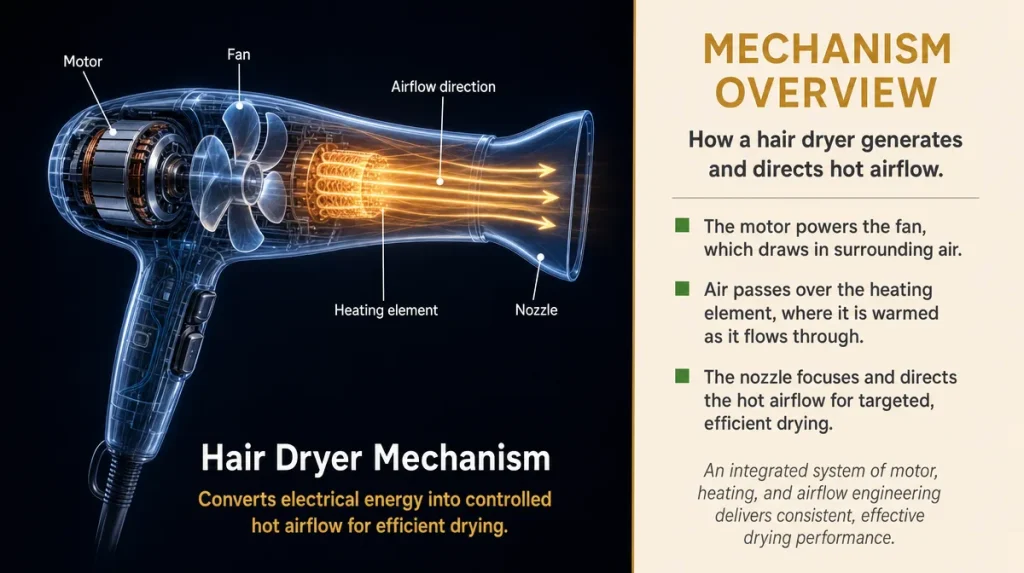
Every hair dryer box shouts its wattage, as if a bigger number automatically means a better dryer. Think of wattage the way you’d think of a car’s engine size alone: it tells you the motor can draw a lot of power, but not whether that power turns into anything useful. A hair dryer’s real job is moving air efficiently across wet hair, and that depends on the fan design and the nozzle shape as much as the motor’s draw.
A 2021 study in the Journal of Cosmetic Science measured drying time against airflow volume across several consumer dryer models and found airflow, not wattage, was the stronger predictor of how quickly hair reached a safe, low-moisture state. High wattage with a poorly shaped fan can actually push more heat at the hair for longer, which increases the risk of surface damage without speeding up the process.
The mistake most buyers make is assuming 1875 watts always outperforms 1600 watts. In practice, a well-engineered 1600-watt motor paired with a narrow, well-angled nozzle can dry hair just as fast, with less heat exposure. When you’re comparing dryers in a drugstore or on Amazon.com, look past the watt number on the front of the box and check whether the listing mentions airflow rating or nozzle design at all. If it doesn’t, that silence tells you something.
Reading Heat Settings Like A Specialist
Heat is where most damage happens, and it’s also where most dryers are least transparent. A dial marked “low, medium, high” tells you nothing about actual surface temperature, which can vary widely between brands even at the same labeled setting.
The household analogy that helps here is an oven with a broken thermostat. You can set it to 350, but if the thermostat cycles poorly, the inside temperature may swing 40 degrees in either direction. Cheaper dryers often work the same way: the heating element cycles on and off unevenly, producing hot spikes that a slower, more controlled dryer avoids even at a nominally higher setting.
A small self-test: hold the back of your hand about six inches from the nozzle on the highest heat setting for three seconds. If it feels uncomfortably hot almost instantly, the dryer likely lacks fine temperature regulation. A dryer built with better heat control will feel warm, strong, but not scorching, even on its top setting, because the internal thermostat is doing its job.
Dermatologists who study hair fiber damage generally point to sustained high heat, not brief exposure, as the bigger risk. That means a dryer that runs at a stable, moderate temperature for a longer session can be gentler than one that blasts hot air in short bursts. Cooler settings paired with more airflow, rather than turning up the heat, is usually the safer way to cut drying time.
Ionic And Ceramic Claims: What’s Real, What’s Marketing
“Ionic” and “ceramic” are two words that appear on nearly every dryer box, and both have a real mechanism behind them, even if the marketing overstates it.
Ionic dryers emit negative ions that are intended to break down water droplets on the hair surface into smaller particles, which may help hair dry faster and appear smoother, according to research summarized in dermatology and cosmetic science literature. Ceramic or tourmaline coatings on the heating element are meant to distribute heat more evenly, reducing hot spots.
The honest picture: these features can help at the margins, but they don’t override poor airflow or poor heat control. A dryer with strong ionic output but weak fan performance will still take longer to dry hair than a well-engineered dryer without any ionic claim at all. Think of these features as a good paint job on a car: worth having, but not a substitute for a solid engine.
A useful mistake to avoid: choosing a dryer based on the number of buzzwords on the box rather than testing airflow and heat stability directly. If a listing leads with “ionic” and “tourmaline” but says nothing about airflow rating, treat those words as decoration until proven otherwise.
The Nozzle And Diffuser Test Most People Skip
A concentrator nozzle narrows and directs airflow, which matters more for smoothing hair and controlling frizz than most people expect. Without one, air disperses in every direction, lifting the hair cuticle instead of smoothing it down, which is part of why bare-nozzle drying often looks rougher.
A quick way to judge nozzle quality in the store: check whether it clicks into place securely and whether the opening is narrow rather than wide and shallow. A loose or wide nozzle scatters air and reduces the directional control that helps hair lie flat.
Diffusers matter for a different reason, mostly for curly and wavy hair patterns. A diffuser slows and diffuses airflow across a wider surface, reducing the frizz that comes from fast-moving air disturbing curl clumps. Testers who evaluate diffusers generally look at bowl depth and the length of the prongs: deeper bowls and longer prongs cradle more hair per pass, which usually means fewer passes and less handling, and less handling generally means less frizz.
The common mistake is buying a dryer for its diffuser photo on the box without checking whether the diffuser actually locks on securely. A diffuser that wobbles or falls off mid-styling defeats the purpose entirely, no matter how good the bowl shape looks in a listing photo.
Weight, Balance, And The Arm-fatigue Problem Nobody Mentions

Specialists who test dryers for a living almost always mention weight and balance before they mention performance, because a dryer that tires your arm changes how you use it, which changes your results.
Hold a candidate dryer the way you’d hold it mid-style, arm extended, wrist slightly bent, for about thirty seconds in the store. If your wrist starts to ache before that half-minute is up, expect that fatigue at home too, especially on longer or thicker hair that takes ten minutes or more to dry.
Weight distribution matters as much as total weight. A dryer that’s heavier at the handle, closer to your grip, feels lighter in use than one that’s front-heavy near the nozzle, even if the two weigh the same on a scale. This is the same principle behind why a hammer feels different held near the head versus near the handle.
The practical cost of ignoring this: a heavy, front-loaded dryer often gets used in short, rushed passes because your arm gives out, which means hair sections get less even heat exposure and you may compensate by cranking the heat higher to finish faster. A lighter, well-balanced dryer, even with a slightly lower wattage, can produce a smoother result simply because you can hold it steady for the full styling pass.
Cord Length, Plug Placement, And The Small Annoyances That Add Up
None of this sounds glamorous, but cord length is one of the top reasons people abandon an otherwise good dryer. A cord under seven feet is often too short to reach comfortably from a bathroom outlet to a mirror across the room, especially in older homes with outlets placed away from the vanity.
Check where the cord attaches to the dryer body. A swivel cord, one that rotates freely at the base, prevents the cord from twisting and kinking as you turn your wrist during styling. Without a swivel, cords tend to develop stress points near the plug, which is a common failure spot.
A small but real detail: dryers used near a sink or shower should carry a grounded, polarized plug and, ideally, sit on a GFCI-protected outlet, a standard safety measure recommended in general home-safety guidance from groups like the American Academy of Dermatology’s broader hair-care safety materials and typical bathroom electrical codes. This isn’t about the dryer’s performance, it’s about basic household safety around water.
The mistake worth naming: judging a dryer entirely in a store display, where cords are usually shortened or taped, and only discovering the real cord length once it’s plugged in at home, several feet short of the mirror.
How To Judge Results Without Overthinking It
Set a timer the first time you use a new dryer on freshly washed, towel-dried hair, and note the total minutes to reach roughly 90 percent dryness. That number becomes your baseline. A dryer that consistently beats your old baseline by several minutes, without leaving hair feeling brittle or straw-like at the ends, is doing its job well.
Check for shine and texture the next morning, not immediately after styling. Heat damage and moisture loss often show up as dullness or increased frizz a day later, once the hair has fully settled, rather than right when it’s still warm from styling.
A fair test runs across at least three to four wash days, not one. Hair porosity, humidity, and how much product you’ve applied all shift results day to day, so one good or bad session doesn’t tell you much about the dryer itself.
What doesn’t matter as much as marketing suggests: color options, app connectivity, or a display screen showing a temperature number. None of these change how the airflow, heat stability, or nozzle design actually performs on your hair.
Key Takeaways
A hair dryer’s real performance comes down to a short list: airflow volume, heat stability, nozzle and diffuser fit, weight balance, and cord practicality. Wattage and buzzwords like ionic or ceramic can help at the margins, but they don’t replace solid engineering in those five areas. Judge a dryer the way you’d judge any tool you’ll hold for ten minutes a day: by how it feels in your hand and how your hair looks the morning after, not by the number printed on the box.
A Quick Checklist Before You Buy
- Check for an airflow rating (CFM) in the product listing, not just wattage
- Hold the dryer at arm’s length for thirty seconds in-store to test wrist fatigue
- Confirm the nozzle clicks on securely and is narrow rather than wide
- If you have curls or waves, check diffuser bowl depth and prong length
- Measure your bathroom outlet-to-mirror distance and compare it to the cord length listed
- Test your first dry with a timer to set a personal baseline for future comparison
This article is for general information only and does not replace advice from a licensed professional.
Individual results vary depending on hair type, texture, and styling habits.