


Marcus Bell, Staff Writer.
You know the drawer. Six, maybe eight tubes of liquid lipstick, all promising a full day of color, most of them abandoned after one wear because they cracked at the corners of your mouth by noon or transferred straight onto your coffee cup. You bought each one hoping it would be the holy grail: the formula that survives lunch, a run to Target, and a phone call without leaving a ring on the glass. Then you peeled it off that night and your lips looked like they’d been through a windstorm. Here is the fact that changes how you shop: most long-wear liquid lipstick failure has nothing to do with the shade or the brand name on the box. It comes down to one ingredient category, film formers, and how your specific lips react to them. Understand that, and you can judge any formula on a drugstore shelf without needing a single review to tell you what to buy.
- Long-wear power comes from film-forming polymers, not pigment load, so a lipstick’s staying power is really a question of chemistry, not color intensity.
- The transfer-resistant finish that survives a coffee cup is the same finish that can dry out your lips, which means comfort and longevity are a genuine trade-off you get to control.
- A 60-second patch test on the back of your hand tells you more about wear time than any online review, because skin oil, saliva chemistry, and lip texture vary too much for other people’s results to predict yours.
What Actually Makes A Lipstick ‘Long-wear’
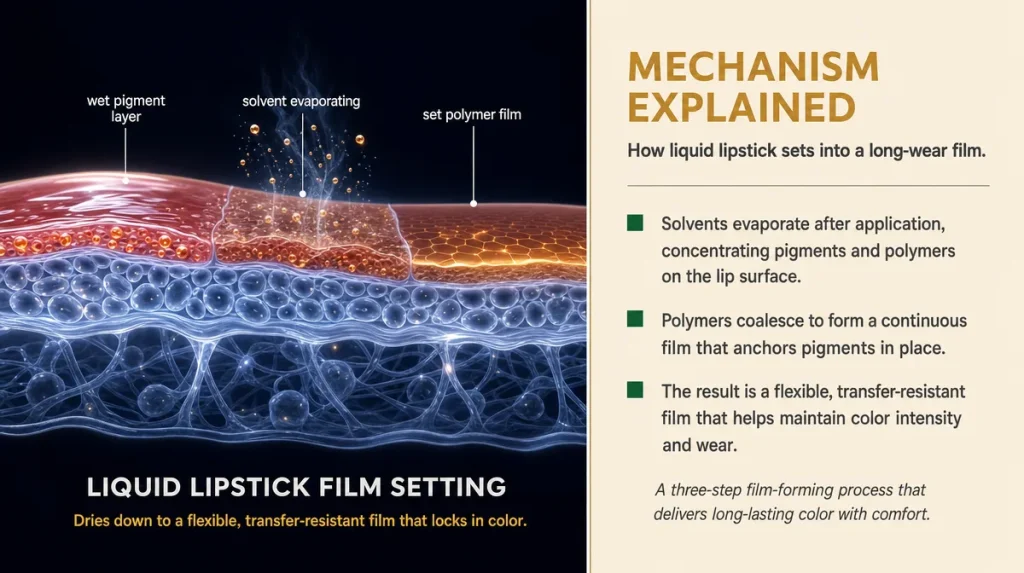
Every long-wear liquid lipstick relies on the same basic trick: a solvent carries pigment and a film-forming ingredient onto your lips, then the solvent evaporates, leaving behind a thin plastic-like layer that grips the skin.
Think of it like nail polish. Wet polish looks glossy and moves easily. Once the solvent evaporates, what remains is a hard, adherent film that resists water and friction. Lip formulas work the same way, just with softer, more flexible polymers so your lips can still move.
A 2021 study in the International Journal of Cosmetic Science found that silicone-based film formers, particularly trimethylsiloxysilicate, produced significantly longer wear times than wax-based formulas in controlled rub tests. That is the ingredient doing the heavy lifting, not the marketing copy about ’24-hour wear.’
The mistake most shoppers make is judging a lipstick by its swatch on the back of the hand right after application. Wet color always looks rich and full. What matters is how the film behaves an hour later, after it has fully set. If you only test wet swatches, you are testing the part of the formula that matters least.
Reading An Ingredient List Without A Chemistry Degree
You do not need to memorize INCI names, but a few categories tell you almost everything.
Near the top of the list, look for silicones (anything ending in -siloxane or -silicate) or for film-forming polymers like PVP or trimethylsiloxysilicate. These are the workhorses of a genuine long-wear claim.
Further down, look for emollients: dimethicone, squalane, various plant oils. These soften the film so it does not crack. A formula with strong film formers and no emollients will wear long and look terrible doing it, cracking into fine lines by hour four.
What is marketing, not chemistry: words like ‘weightless,’ ‘second-skin,’ or ‘transfer-proof’ printed on the box tell you nothing about the actual formula underneath. They describe a feeling the brand wants you to expect, not a measurable property. The ingredient list is the only part of the packaging that is regulated for accuracy in the US, so it is the only part worth reading closely.
The Oil-water Trade-off Nobody Explains At The Counter
Every long-wear formula sits somewhere on a spectrum between two extremes: pure film formers, which last the longest but dry out fastest, and hybrid formulas that mix in emollients and lose some staying power in exchange for comfort.
There is no formula that maximizes both. This is not a flaw in any particular product, it is basic chemistry: the same polymer network that resists water and oil transfer also blocks moisture from moving in and out of the film, which is why long-wear formulas dry the lips more than a standard cream lipstick.
A 2020 study in the Journal of Cosmetic Dermatology measured transepidermal water loss on lips wearing long-wear versus cream formulas over six hours and found meaningfully higher moisture loss under the long-wear film. That does not mean these formulas are unsafe. It means comfort has a cost, and you get to decide how much of it you are willing to pay.
If your lips are already prone to dryness or you live somewhere with dry winters and heated indoor air, a common condition on much of the East Coast once the furnace turns on, you may want to lean toward a hybrid formula and accept slightly less wear time in exchange for lips that do not flake by evening.
Doing Your Own Patch Test Before You Commit
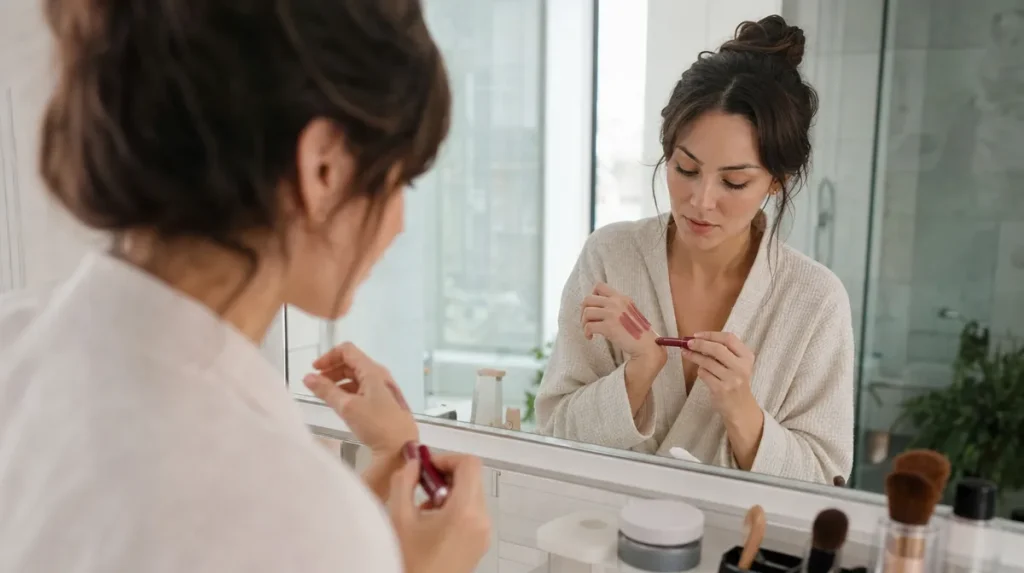
Before you buy anything, do this at the counter or with a sample: apply a small amount to the back of your hand, let it dry fully for two full minutes, then rub it firmly with a cotton pad five times.
If color transfers heavily onto the pad, the formula’s film has not set properly for your skin’s oil level, and it likely will not survive lunch either. If the color barely moves but the patch feels tight and stiff within a minute, that is your early warning for how your lips will feel by the third hour of wear.
This test takes under a minute and tells you more than any five-star review, because reviews are written by people whose skin oil, saliva pH, and lip texture are not yours. Wear time varies genuinely from person to person, not just formula to formula.
A useful habit: keep a small notebook or note on your phone of which formulas passed your own patch test and which cracked or transferred. Over a few months you will notice you gravitate toward one or two ingredient types, silicone-heavy or hybrid, and that pattern is more useful than any brand loyalty.
The Corners-of-the-mouth Problem And How To Prevent It
The most common failure point on any long-wear lipstick is the corner of the mouth, where the skin folds and flexes constantly through talking, eating, and smiling.
Film-forming layers are rigid by design. Rigid materials crack at flex points the same way a phone screen protector cracks first at its corners, not its center. This is a mechanical limitation of the format, not a sign of a bad batch.
Two habits reduce it meaningfully. First, apply a thin layer of lip balm to just the corners before the color, so the film there stays slightly more flexible. Second, avoid over-applying at the corners in the first place, a thick film cracks faster than a thin one.
If you notice cracking within an hour regardless of technique, that is useful information about your own lip movement and saliva exposure, not a reason to keep buying different lipsticks hoping for a fix. It may simply mean a hybrid formula suits you better than a pure long-wear one.
Judging Results Honestly: What ‘Wear Time’ Should Mean
When a package claims ‘8-hour wear,’ that number usually comes from a lab test involving controlled conditions: no eating, no drinking, no talking for extended periods, sometimes not even normal humidity.
Your real day involves coffee, lunch, a lip balm reapplication you forgot about, maybe a mask. A formula that claims 8 hours may visibly fade to a stain by hour four in ordinary use, and that stain, not total disappearance, is actually the expected end stage of a long-wear formula working correctly. The pigment that remains after the top film wears away is doing its job.
Judge a formula on three checkpoints across a normal day: right after lunch, mid-afternoon, and at day’s end. If it holds reasonably through lunch and fades to an even stain by evening rather than patching unevenly, that is a formula performing as designed. Uneven patching, especially concentrated in the center of the lip where food and drink contact is highest, suggests the film is thinner than it should be there, often from underapplication.
Undertone And Daylight: Getting The Shade Right The First Time
Store lighting, especially the warm bulbs common in many drugstore beauty aisles, shifts how a shade looks in the tube compared to daylight. A color that looks like a true red under fluorescent light can read orange-toned the moment you step outside.
The fix is simple: swatch on your inner wrist, then walk to a window or step outside for ten seconds before deciding. Natural light is the only reliable light for judging undertone.
US shade ranges (fair, light, medium, tan, deep) describe depth, not undertone, so two people in the ‘medium’ range can need very different color families depending on whether their undertone leans warm, cool, or neutral. A quick self-test: look at the veins on your inner wrist in daylight. Green-toned veins generally suggest a warmer undertone; blue-toned veins suggest cooler. Neither reading is exact, but it narrows the field before you start swatching.
When To Walk Away From A Formula Entirely
Some reactions are not about technique. If a formula causes persistent stinging, swelling, or peeling beyond ordinary dryness, that is worth discussing with a dermatologist rather than solving with a different long-wear lipstick.
The American Academy of Dermatology’s public guidance on lip care notes that persistent lip irritation can sometimes stem from a specific ingredient sensitivity rather than the product category as a whole, and recommends patch testing new products and discontinuing use if irritation persists.
If you have ruled out a sensitivity and the issue is simply dryness or flaking, that is a formulation trade-off, not a medical one, and the fixes above (corner balm, thinner application, choosing a hybrid formula) usually resolve it within a wear or two. Give any new habit a fair trial across a few applications before deciding it does not work for you, since first-time application technique is often the real variable.
Key Takeaways
Long-wear performance comes from film-forming ingredients, not marketing language on the box. Reading the ingredient list, not the front label, tells you what a formula will actually do.
There is a genuine trade-off between long wear and lip comfort. Decide which matters more to you before you shop, especially if you deal with dry winters or already sensitive lips.
Your own patch test, done in under a minute, predicts your real-world wear time better than any review written by someone else’s lips.
A Quick Checklist Before You Buy
- Check the ingredient list for a film-forming polymer or silicone near the top, and an emollient further down
- Swatch in daylight, not store lighting, before judging the shade
- Do a two-minute dry-and-rub patch test on your hand before committing
- Apply a thin layer of balm to the corners of your mouth first if you tend to crack there
- Judge wear time at three checkpoints across a real day: after lunch, mid-afternoon, and evening
- If irritation persists beyond ordinary dryness, treat it as a sensitivity question, not a shopping question
This article is for general information only and does not replace individualized medical or dermatological advice.
Results and wear time vary from person to person depending on skin chemistry and application technique.