


Priya Nandakumar, Staff Writer.
The question usually shows up around 7:40 in the morning, phone propped against the bathroom mirror, a half-used palette open on the counter: which shades, in what order, and whether any of it will still be in place by lunch. Most people answer it by trial and error, buying a new palette every few months and hoping the next one behaves better than the last. The real issue is rarely the palette itself. Eyeshadow fails for mechanical reasons that have nothing to do with how expensive or trendy it is: the eyelid produces its own oil, moves constantly, and gives pigment very little to grip onto without some help. Understanding that one fact changes almost everything else about how to shop, apply, and judge results. This guide walks through a routine built around how skin actually behaves, not around how a palette looks swatched once under store lighting.
- Undertone, not the name on the shadow, decides what looks vivid versus muddy: a two-minute daylight check settles it for good.
- Creasing is a hydration and friction problem, not a skill problem: a thin base layer fixes most of it before color ever goes on.
- Three shades cover nearly every look worn day to day: a transition, a lid color, and a deepener, applied in that order, outperform a crowded palette.
Finding Your Undertone In Daylight

Most shade confusion starts under the wrong light. Department store counters and drugstore aisles tend to use cool fluorescent tubes that flatten warm tones and exaggerate cool ones, so a shadow that looks golden under those lights can read green once you get home.
The fix is simple: step near a window before deciding anything. Natural daylight is the only consistent reference point, the same way a paint chip looks different taped to a wall at noon than it does under a showroom spotlight.
Undertone has nothing to do with how fair, medium, tan, or deep a skin reading is. It is about whether skin leans warm (gold, peachy, olive-leaning), cool (pink, blue-leaning), or neutral, a mix of both. Checking the veins on the inside of the wrist in daylight is a reliable shortcut: green-leaning veins usually mean warm undertone, blue-leaning veins usually mean cool, and a mix of both usually means neutral.
Once undertone is clear, shade families tend to sort themselves out. Warm undertones generally look most lit-up in copper, bronze, and olive-based shadows. Cool undertones tend to favor mauve, plum, and true gray. Neutral undertones can usually wear both, which is the main advantage of landing in that category.
Self-test: hold a shadow pan against the inner wrist in daylight rather than the back of the hand, which tans differently and can mislead the comparison. If the color looks like it belongs on the skin rather than sitting on top of it, that is the signal to buy.
Why Eyeshadow Creases By Midafternoon
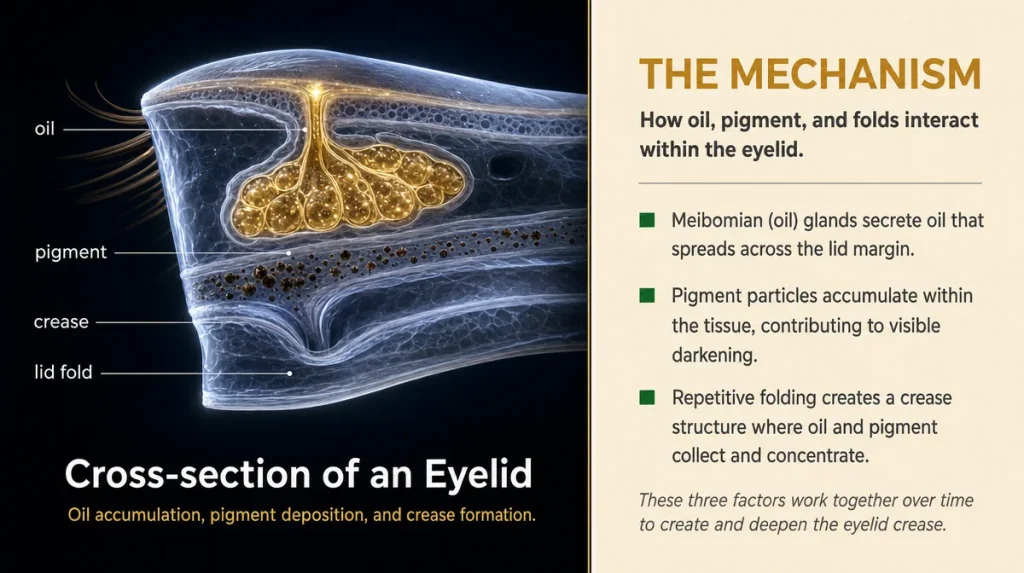
Creasing is often blamed on bad technique, but the real cause is simpler: oil and movement. The eyelid is one of the thinnest, most mobile areas of skin on the body, producing its own oil and folding dozens of times an hour with every blink. Pigment sitting on top of that moving, oily surface migrates into the crease line over the course of a day, the way chalk drawn on a damp sidewalk smears into the cracks.
People with naturally oilier lids see this faster, sometimes within two to three hours. Drier lids can go most of a workday before any noticeable shift.
The standard mistake is reapplying color directly over the crease once it appears, which only hands the oil more pigment to move around again. The better fix happens before a shadow brush is ever picked up: a thin layer of eye primer, or in its absence a small amount of translucent powder pressed, not swiped, onto the lid, gives pigment something to hold onto besides skin oil.
A 2019 study in the International Journal of Cosmetic Science on eye makeup longevity found that a mattifying base layer extended wear time by several hours compared with shadow applied directly to bare lid skin, largely by reducing oil migration rather than by changing the pigment itself.
Judge results honestly by checking the lid at midday rather than right after application. If color has gathered in the fold while the rest of the lid still looks clean, the base step, not the shadow, needs attention next time.
The Three-shade Method That Replaces A Crowded Palette
A ten- or twelve-pan palette looks generous in the store, but most people who wear eyeshadow daily return to the same three shades out of a dozen, every time. Building a routine around that reality saves both time and product.
The three roles worth knowing: a transition shade, a lid shade, and a deepener. The transition shade sits in the crease and blends the lid color into the brow bone, usually a soft matte close to the wearer’s own skin tone. The lid shade is the main color, swept across the lid itself. The deepener is a darker tone used sparingly along the lash line or outer corner for definition, without redoing the whole eye.
Applied in that order, transition first, then lid, then deepener, each layer has something to blend into rather than sitting on bare skin, which also helps with the creasing problem described above.
The common mistake is applying the darkest shade first because it looks dramatic in the pan, then spending several minutes trying to soften a hard edge that would not have existed with a different order.
Once the sequence feels automatic, most of a crowded palette becomes unnecessary. It is worth testing on an ordinary day with no particular plans: time a transition, lid, and deepener look, then compare it with how long the usual routine takes. For most people, the shorter method also lasts longer on the skin, because fewer layers mean less total product for oil to break down.
What Primer Actually Does To The Base
Primer can sound like an upsell until the mechanical problem it solves is clear. Bare eyelid skin is slightly oily and slightly uneven in texture, with fine lines near the crease and sometimes mild redness near the lash line. Pigment applied straight onto that surface has an uneven base to cling to, the way paint goes on patchy over a wall that has not been primed first.
A proper eye primer does two things: it creates a slightly tacky surface for pigment to grip, and it neutralizes some of the natural skin tone underneath so colors read truer. Face moisturizer does neither. Moisturizer’s job is to keep skin soft and slightly hydrated, which is close to the opposite of what shadow needs in order to hold.
A shortcut some people use instead of primer is a thin layer of concealer set with powder. This can work reasonably well for grip, though it often shifts the shadow color more than a dedicated primer does, since concealer is opaque and primer usually is not.
Skin type changes how much primer matters. Oilier lids benefit most, often needing it daily. Drier lids may get by without it in warmer months but notice creasing return once indoor heating season starts drying the air and, somewhat counterintuitively, increasing how much the skin compensates with surface oil.
To test whether a current base step is holding, press a clean finger lightly on the lid an hour after application. If pigment transfers visibly to the finger, the base is not doing its job.
Blending Without The Smudged, Dirty Look
The difference between a blended eye and a muddy one usually comes down to pressure and order, not raw skill. Pushing a brush back and forth hard across two colors mashes them into a single flat tone, the way mixing two paint colors directly on a wall creates mud rather than a gradient.
The better method is light, repeated circular motion at the boundary where two shades meet, using a clean, fluffy brush with almost no product left on it. Think of it as feathering the edge where colors overlap rather than scrubbing them together.
A frequent mistake is applying too much pigment before blending even starts. A heavily loaded brush leaves little room to soften edges without smearing the whole area. Tapping excess powder off the brush before it touches the lid solves most of this before it becomes a problem.
Order matters as well. Blending the transition shade first, while the lid is still clean, works better than trying to soften edges after three colors are already layered on top of each other.
A quick self-test: look at the eye from arm’s length in a mirror rather than up close. Close up, every imperfection in blending looks magnified. From a normal conversational distance, which is how other people actually see a face, small unevenness tends to disappear entirely. Judging results at the wrong distance is one of the most common reasons people think their blending is worse than it is.
Matching The Routine To How The Day Actually Goes
A routine only holds up if it matches the conditions it has to survive. Humidity, heat, and activity level all change how long eyeshadow lasts, sometimes more than the formula itself does.
On humid days, common across much of the East Coast in summer, oil production increases and sweat near the hairline and temples can migrate toward the eye area over several hours. A slightly heavier hand with primer and a translucent powder set helps more on those days than switching formulas entirely. Dry winter air, especially indoors with heating running, tends to make shadow look chalky or patchy rather than oily, which calls for a light mist of setting spray or a cream base instead of powder-only steps.
Activity matters as much as weather. A desk day with minimal movement and air conditioning is a low-demand environment for makeup. A day that includes a workout, an outdoor event, or several hours outside calls for a simpler, more water-resistant approach, since even well-blended shadow cannot fully resist sweat and repeated touching.
The mistake many people make is using the exact same routine regardless of what the day holds, then being surprised when it fails on a hot, humid afternoon or a long outdoor stretch. A brief mental check before starting, what is the weather, how active will today be, how long does this need to last, does more to extend wear time than any single product choice.
Judging Formula Quality Before You Buy
Not every eyeshadow performs the way its swatch promises, and most of the difference comes down to pigment load and particle size rather than price.
Pigment load is how much actual color sits in the formula relative to filler. A shadow with high pigment load shows strong color with one light swatch. A low-pigment shadow needs several layers to reach the same intensity, builds unevenly, and tends to show brush strokes.
Fallout, loose powder that drifts down onto the cheeks during application, is a separate issue tied to particle size and binder quality rather than pigment strength. A shimmery shadow with large, loosely bound particles sheds more fallout than a finely milled matte in the same range.
None of this requires a lab to check. A simple in-store or at-home test works: swatch the shadow once on the back of the hand, wait a few seconds, then lightly tap the area. Heavy fallout on the counter or on a sleeve is a visible warning sign. Rubbing the swatch gently also reveals whether color transfers cleanly or smears into a gray haze, a sign of a poorly bound pigment.
Lab-testing organizations such as the Good Housekeeping Institute have long used standardized swatch and wear tests to evaluate cosmetics for general publication, a useful model for the kind of informal check anyone can do at a counter or kitchen table before committing to a full palette.
Knowing When To Retire A Palette
Eyeshadow does not last indefinitely, even when the pigment still looks fine. Pressed powder formulas typically hold up for around two years once opened, while cream shadows, which carry more oil and moisture, often need replacing closer to the one-year mark.
Texture change is usually the first sign. A once-smooth pan that starts to feel dry, cracked, or hard to pick up with a brush has likely lost the oils that kept it blendable. A cream formula that has separated, with a thin layer of oil visible on the surface, has passed the point where it applies evenly.
General guidance on eye-area cosmetics, including material published by the American Academy of Dermatology on makeup hygiene, points to regular replacement as a basic precaution, since repeated brush contact and exposure to air introduce bacteria over time, particularly in a product used so close to the eye.
A reasonable habit is checking any eye palette twice a year, around the change of seasons, for smell, texture, and how easily color picks up. Fragrance that has shifted, even slightly, is often the clearest signal before texture changes show up.
The instinct to hold onto a near-empty palette because it is a long-time favorite is understandable, but a palette that has dried out no longer performs the way it did when new. At that point it works against the rest of the routine rather than for it, no matter how well everything else is done.
Key Takeaways
- Undertone decides which shade families look vivid, not how fair, medium, tan, or deep a complexion reads. A daylight wrist check settles it in under a minute.
- Creasing is mostly an oil and movement problem. A thin primer layer or pressed translucent powder before color goes on solves most of it.
- Three roles, a transition, a lid shade, and a deepener, cover nearly every look worn day to day, applied in that order.
- Heavy-handed blending creates mud. Light, repeated motion with a clean brush and minimal product feathers color instead of smearing it.
- Weather and activity level change how a routine should be built each day, more than any single formula does.
- Pigment load and fallout, not price, tend to separate formulas that perform well from ones that do not.
- Eye makeup has a practical shelf life. Texture and smell, checked twice a year, are the clearest signals that a palette needs replacing.
A Quick Checklist Before You Start
- Check undertone near a window, not under store lighting.
- Apply a thin primer or pressed powder base before any color.
- Work transition, then lid, then deepener, in that order.
- Blend with light circular motion and a nearly clean brush.
- Check results at midday and from a normal conversational distance, not immediately after application or up close.
- Adjust for weather and activity before deciding how heavy-handed to be.
- Swatch and tap-test any new formula for fallout before relying on it for a full look.
- Check favorite palettes twice a year for texture and smell.
This article is for general information only and does not replace individualized advice from a dermatologist or licensed esthetician.
Results and wear time described here vary by individual skin type, climate, and product formula.